
As manufacturers, we understand that buyers are not just comparing materials — they are choosing long-term safety, durability, and investment value. Below is a complete, practical comparison that addresses performance, cost, lifespan, safety, and application suitability so you can make a confident decision.
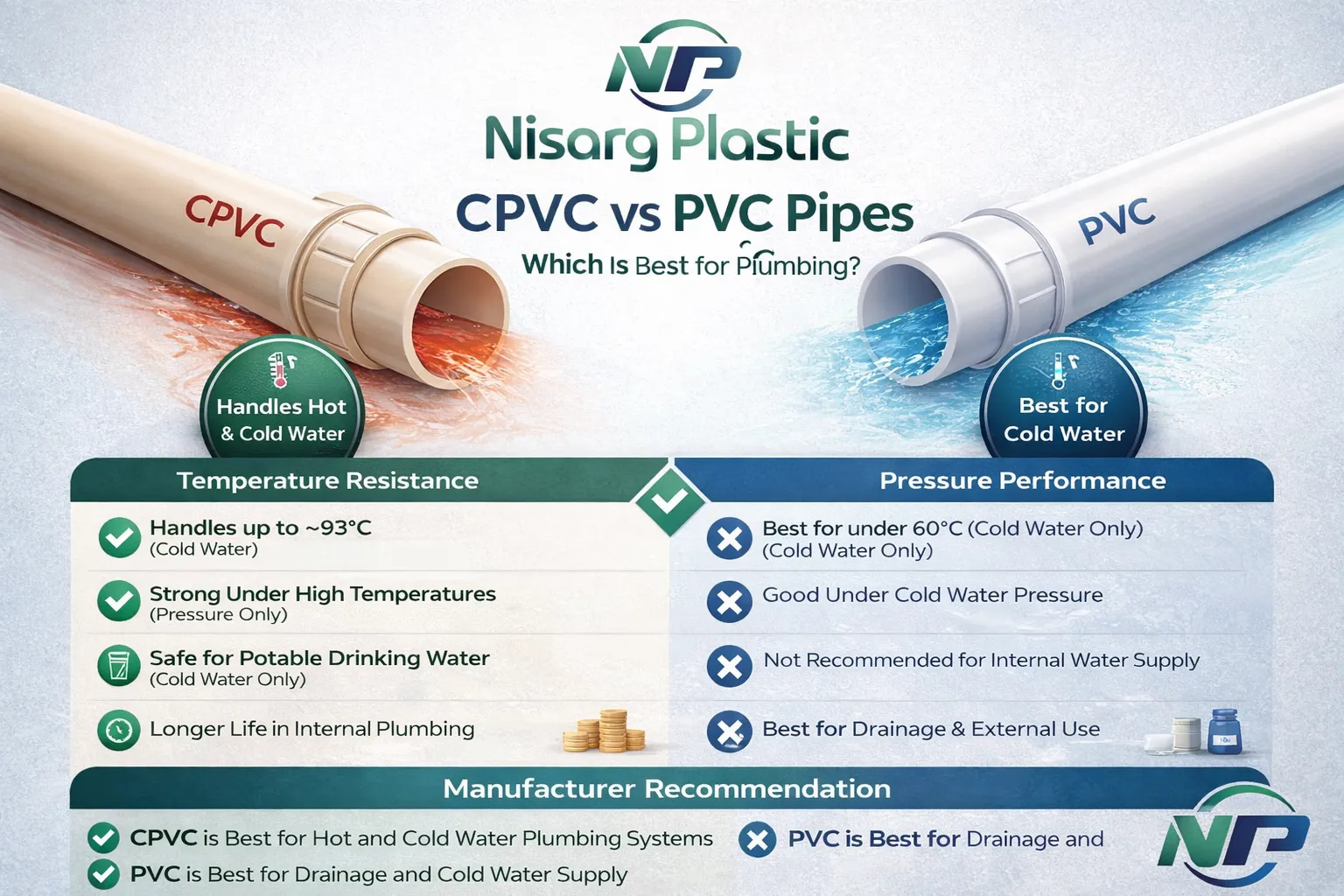
1. What Is the Core Difference?
PVC (Polyvinyl Chloride)
Primarily designed for cold water supply, drainage, irrigation, and waste systems.
CPVC (Chlorinated Polyvinyl Chloride)
A modified version of PVC engineered to handle both hot and cold water plumbing.
The fundamental difference lies in temperature resistance and internal plumbing capability.
2. Temperature Resistance
PVC:
- Recommended mainly for cold water
- Starts softening at higher temperatures
- Not suitable for geyser or hot water lines
CPVC:
- Handles temperatures up to approximately 93°C
- Suitable for hot and cold water supply
- Maintains strength even under continuous heat exposure
If your plumbing includes hot water, CPVC is the technically correct choice.
3. Pressure Performance
PVC:
- Strong under normal cold water pressure
- Suitable for underground and external applications
CPVC:
- Maintains pressure-bearing capacity even at high temperatures
- Ideal for multi-storey buildings and pumped systems
For concealed plumbing inside walls, pressure reliability becomes critical — CPVC performs better.
4. Drinking Water Safety
CPVC:
- Designed for potable water systems
- Corrosion-resistant
- Resistant to scaling and internal deposits
- Performs well with hard or chemically treated water
PVC:
- Commonly used for drainage and cold water transport
- Not typically recommended for full internal potable plumbing systems
For hygienic internal water supply, CPVC is widely preferred.
5. Durability and Lifespan
Both materials:
- Do not rust
- Resist corrosion
- Require minimal maintenance
CPVC:
- Better resistance to thermal aging
- Suitable for 40–50 years of service life when properly installed
For long-term concealed plumbing, durability under temperature variation matters — CPVC has the advantage.
6. Cost Comparison
PVC:
- Lower initial purchase cost
- Best for drainage and external use
CPVC:
- Slightly higher upfront cost
- Reduces risk of future leakage in hot water lines
- Lower lifetime maintenance expense
A small initial difference often prevents costly repairs later.
7. Installation
Both pipes:
- Lightweight
- Easy to cut and handle
- Installed using solvent cement joints
- Faster installation than metal piping systems
Important:
- CPVC requires CPVC-grade solvent cement.
- Proper transition fittings must be used if connecting PVC and CPVC.
8. Best Applications
PVC is ideal for:
- Underground drainage
- Wastewater systems
- Rainwater lines
- Irrigation systems
- Cold water external supply
CPVC is ideal for:
- Hot and cold water plumbing
- Bathrooms and kitchens
- Residential apartments
- Commercial buildings
- Hospitals and hotels
9. Common Buyer Concerns Answered
Can PVC be used for hot water?
No. It may deform and weaken over time.
Is CPVC safe for drinking water?
Yes. It is specifically developed for potable water systems.
Which pipe lasts longer?
Both are durable, but CPVC performs better in internal hot water systems.
Is CPVC worth the higher price?
Yes, especially for concealed plumbing and hot water lines where failure costs are high.
Can both be used in one project?
Yes, when each is used for its correct application and joined with proper fittings.
Our Final Recommendation
There is no single “better” pipe — only the right pipe for the right purpose.
Choose PVC for drainage and cold water systems where cost efficiency is the priority.
Choose CPVC for complete internal plumbing systems involving hot and cold water, where safety, durability, and long-term reliability are essential.
Making the correct material selection today ensures performance, safety, and reduced maintenance for decades.
