
Selecting the right piping material for a hot water system is not a minor technical decision. It directly affects durability, safety, maintenance cost, and long-term performance of the entire plumbing network.
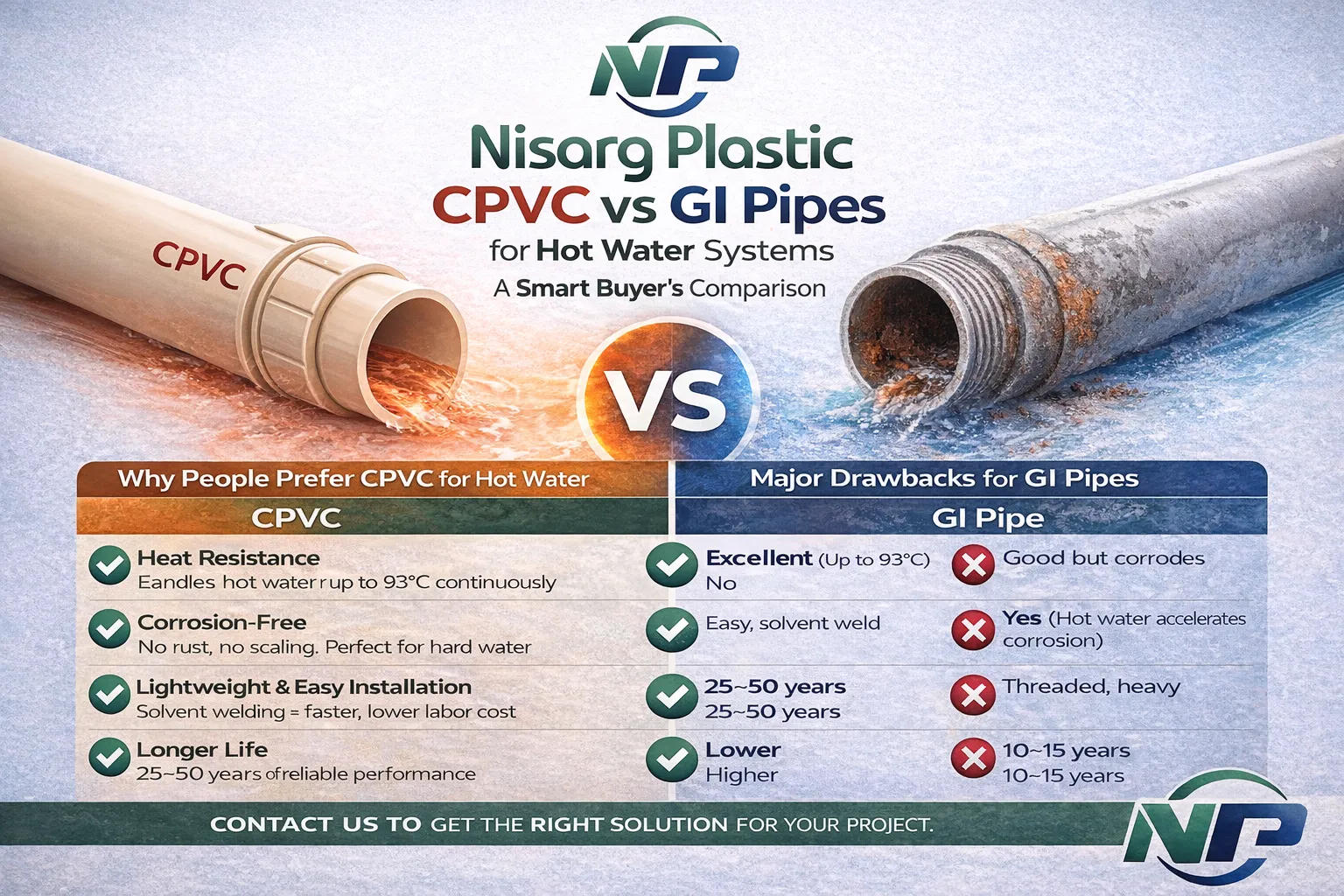
Many projects still compare CPVC and GI pipes based only on upfront material cost. However, hot water applications demand far more than basic strength. Temperature, pressure, water chemistry, and time all play a critical role in determining which material will truly perform.
As a manufacturer supplying piping systems for residential, commercial, and institutional projects, we believe buyers must evaluate performance over decades — not just at the time of purchase.
CPVC Pipes in Hot Water Systems
CPVC (Chlorinated Polyvinyl Chloride) is specifically engineered for hot and cold water distribution.
Designed for High Temperature Stability
CPVC pipes are built to handle continuous hot water temperatures up to approximately 93°C. This makes them suitable for:
- Residential geyser connections
- Solar water heater lines
- Centralized hot water systems
- Hotels, hospitals, and commercial buildings
Unlike conventional materials, CPVC maintains structural integrity under sustained thermal stress.
Zero Corrosion Risk
Because CPVC is non-metallic, it does not rust, corrode, or react with water minerals. In hot water systems, this is a decisive advantage.
Over time, CPVC maintains:
- Smooth internal surface
- Consistent internal diameter
- Stable water pressure
- Clean water flow without rust contamination
This is particularly important in regions with hard water conditions.
Long-Term Service Life
When properly installed, CPVC piping systems typically offer a service life of 25 to 50 years in hot water applications, with minimal maintenance requirements.
GI Pipes in Hot Water Systems
GI (Galvanized Iron) pipes are steel pipes coated with zinc to slow corrosion. They were widely used in older plumbing systems due to their mechanical strength.
Strength vs. Suitability
While GI pipes are rigid and impact-resistant, strength alone does not determine suitability for hot water distribution.
Corrosion in Hot Water
Hot water accelerates the breakdown of the protective zinc coating. Over time:
- Internal rust forms
- Scaling builds up
- Pipe diameter reduces
- Flow and pressure drop
- Leak risks increase
This degradation is gradual but unavoidable in hot water systems.
Shorter Lifecycle
In typical hot water applications, GI pipes may require replacement within 10–15 years depending on water quality and operating conditions. Maintenance costs increase as corrosion progresses.
Installation and Lifecycle Cost Comparison
A responsible buying decision must consider total cost of ownership, not just purchase price.
Key factors include:
- Installation labor
- Maintenance frequency
- Replacement cycles
- Flow efficiency over time
CPVC pipes are lightweight and installed using solvent welding, reducing labor complexity. GI pipes require threading, heavier handling, and higher installation effort.
Although GI may sometimes appear less expensive per meter, long-term repair, replacement, and performance loss often make it more costly over the system’s lifespan.
The Real Difference: Performance After 10 Years
The most important question buyers should ask is not, “What is the cost today?”
It is, “How will this system perform after 10, 20, or 30 years?”
CPVC is engineered to maintain performance consistency.
GI gradually deteriorates in hot water conditions.
For projects where durability, reliability, and low maintenance are priorities, material selection should reflect long-term thinking.
Make an Informed Decision
Hot water systems operate daily, under continuous thermal stress. Choosing the right piping material protects your investment, reduces future disruptions, and ensures dependable performance.
As a manufacturer committed to delivering high-quality piping solutions, we encourage buyers, consultants, and contractors to evaluate materials based on lifecycle value and application suitability.
If you are planning a residential, commercial, or institutional project and need technical guidance on selecting the right hot water piping system, contact us. Our team will assist you with product specifications, performance data, and application recommendations tailored to your project requirements.
